Feather Keratin Hydrolysis at Rendering Plants: Pilot Trial, QC and Cost-in-Use
Plan an enzyme trial for feather keratin hydrolysis at a rendering plant: process window, QC checks, supplier documents and cost-in-use per tonne of feathers. Request a quote.
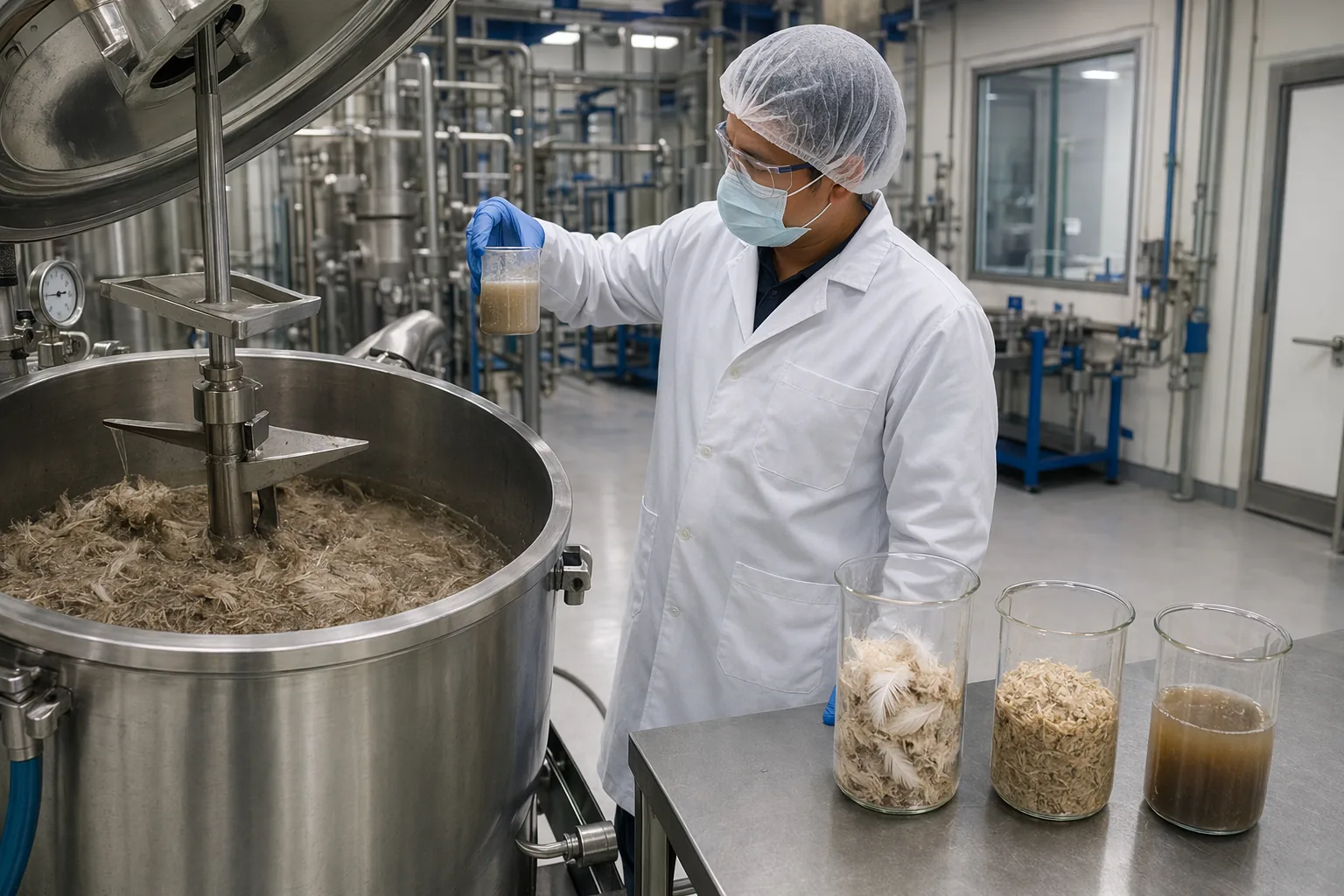
Feathers arrive at rendering plants as a tough, cross-linked keratin complex that cooking and grinding alone convert slowly. This guide is for rendering and by-product processors, and the distributors who supply them, planning an enzyme step: the process window, the QC that proves it works, the documents to ask for, and how to judge cost per tonne of feathers.
To trial it, send the product (activity grade), quantity and destination with a short profile of your feather stream; we quote per order.
Why Feather Keratin Needs a Targeted Enzyme
Feathers contain a highly cross-linked keratin complex that resists simple cooking, grinding, and many general proteases. A targeted keratinase, often described as a feather degradation enzyme, supports keratin hydrolysis by opening the protein structure and releasing more accessible peptides and amino acids. For rendering plants, the goal is predictable bioconversion of poultry by-product into a usable feed or fertilizer ingredient according to local regulations and customer specifications. When evaluating a keratinase enzyme, buyers should compare activity on actual feathers, not only generic protein substrates. Useful supplier data includes hydrolysis curves, degree of solubilization, amino nitrogen release, viscosity or slurry handling observations, and heat profile compatibility. The best fit depends on raw feather variability, particle size, sanitation requirements, and whether the process is batch, semi-continuous, or integrated with thermal rendering.
Targets insoluble feather keratin rather than soluble proteins only • Supports improved hydrolysis under controlled moisture, pH, and heat • Should be validated on the buyer’s own feather stream
Recommended Process Window for Pilot Trials
A practical keratinase screening program usually starts with a controlled slurry of washed or rendered feathers at defined solids content. Our grades are specified for pH 7.0–10.0 and 50–70 °C; set the trial inside that window and confirm the final range with your own pilot data. Dosage may be screened from about 0.1-1.0% enzyme product on feather dry weight, or by declared activity units per gram of substrate when the supplier provides a reliable method. Residence time depends on particle size, solids loading, pretreatment and target hydrolysis, so set it from a time-course run on your own feathers. Avoid assuming that higher dosage always lowers cost-in-use; enzyme price, reaction time, energy input, yield, and downstream drying cost must be reviewed together. Maintain agitation sufficient to wet feathers and prevent clumping, but avoid shear conditions that damage equipment or cause excessive foaming.
Start inside pH 7.0–10.0 and 50–70 °C • Run a dosage ladder and time-course analysis • Track moisture, solids, mixing, and final drying load
Quality Control Checks for Keratin Hydrolysis
QC should connect enzyme performance to the commercial specification for feather meal. At minimum, measure initial and final dry matter, crude protein, soluble protein or peptides, pH drift, residual moisture, and visual feather breakdown. For process development, add degree of hydrolysis, amino nitrogen, digestibility testing where applicable, and microscopy or sieve analysis to observe remaining feather fragments. If feather meal is sold into feed channels, coordinate testing with relevant regulatory and customer requirements; if used for fertilizer, nutrient release and stability may be more important. Microbial control, odor, and sanitation should also be monitored because extended warm hydrolysis can create process risks. Request the supplier’s activity assay and confirm whether activity is measured on keratin, azocasein, casein, or another substrate. Different assays can make two keratinase products look similar on paper while performing differently on real feathers.
Use real feather substrate in validation • Compare soluble nitrogen and remaining feather residue • Confirm the activity assay behind the stated units • Monitor microbiology, odor, and batch-to-batch variation
Supplier Documents Buyers Should Request
Before purchasing at production scale, ask for a complete document pack: Certificate of Analysis, Technical Data Sheet, Safety Data Sheet, recommended storage conditions, shelf-life, packaging options, activity method, and handling precautions. The COA should identify the batch, declared activity, production date or retest date, and relevant physical properties such as appearance and moisture if applicable. The TDS should define recommended pH, temperature, dosage guidance, inactivation conditions, and compatibility notes. The SDS should support safe warehouse and plant handling by EHS teams. Also ask whether the supplier can provide pilot trial protocols, sample quantities, stability data under shipping conditions, and change notification procedures. Avoid relying on unverifiable claims or generic statements such as “high activity” without a method, substrate, and unit definition. For B2B procurement, documentation quality is often as important as the initial unit price.
COA for batch-specific activity and traceability • TDS for process application guidance • SDS for safe handling and EHS review • Pilot protocol and sample support for validation
Cost-in-Use and Scale-Up Considerations
The lowest quoted price per kilogram is rarely the best indicator of feather meal economics. Calculate cost-in-use by including enzyme dosage, reaction time, steam or heat input, pH adjustment, water use, agitation, yield, drying energy, labor, and any change in final product value. During scale-up, compare lab beaker results with pilot tanks because feather wetting, solids loading, and heat transfer can change keratinase performance. Define acceptance criteria before trials: minimum solubilization, target digestibility, maximum residual feather, acceptable odor, batch time, and cost per metric ton of feathers processed. If a supplier proposes a blend, confirm the role of keratinase versus general protease and whether performance remains stable over storage.
Model cost per metric ton of feather input • Set technical acceptance criteria before pilot trials • Validate mixing, heating, and pH control at scale • Compare enzyme blends using the same substrate and assay plan
Technical Buying Checklist
1. Feather stream: source, washing step, moisture, particle size and how much it varies from day to day.
2. Grade: 50,000 or 100,000 U/g, and the assay behind the units (ours is the keratin azure assay).
3. Window: can the line hold pH 7.0–10.0 and 50–70 °C for the residence time you need?
4. Trial: a dosage ladder and a time course on your own feathers, with an untreated control.
5. Acceptance: minimum solubilization, maximum residual feather, odor and batch time, agreed before the pilot.
6. Supply: pack size (1 kg, 5 kg or 25 kg), quantity per order or per year, and destination for the quote.
Request a Quote for a Feather Trial
Rendering plants, by-product processors and the distributors who supply them request quotes the same way: send the product (activity grade), the quantity and the destination country, with a short profile of your feather stream. Packs are 1 kg, 5 kg and 25 kg, MOQ 1 kg, and price is quoted per order. Free sample included with every qualified inquiry.
Keratinase for Research & Industry
Need Keratinase for your lab or production process?
ISO 9001 certified · Food-grade & research-grade · Ships to 80+ countries
Frequently Asked Questions
What is keratin in the context of feather meal?
Keratin is a tough structural protein found in feathers, hair, wool, and similar materials. In feathers, it forms a resistant keratin complex with strong bonding and low solubility, which makes ordinary processing less efficient. For feather meal production, keratinase is used to support controlled keratin hydrolysis so the material becomes more accessible for downstream feed or fertilizer specifications.
How should we compare two keratinase enzyme products?
Compare them on the same feather substrate, solids level, pH, temperature, dosage, and residence time. Ask each supplier for the activity assay method, because declared units may be based on different substrates and cannot always be compared directly. Review COA, TDS, SDS, stability, batch consistency, pilot support, and cost-in-use per metric ton of feathers, not just price per kilogram.
Can keratinase replace thermal processing in feather meal?
Keratinase is usually evaluated as part of an integrated process, not as a universal replacement for thermal treatment. Heat may still be needed for sanitation, feather conditioning, enzyme inactivation, drying, or product stability. The right process depends on local regulations, customer requirements, equipment, and target product quality. Pilot validation should define where enzymatic hydrolysis improves performance without creating unacceptable time, odor, or microbial risks.
What pilot trial data should an industrial buyer collect?
Collect starting feather composition, particle size, moisture, solids loading, pH, temperature, enzyme dosage, mixing speed, time points, and final dry matter. Analytical data should include soluble protein, amino nitrogen or degree of hydrolysis, residual feather fragments, crude protein, odor, and microbiology where relevant. Record energy use, pH adjustment, water addition, and drying impact so procurement can calculate practical cost-in-use.
Are keratin treatment and keratin hair treatment related to this application?
Only at the keyword level. Consumer phrases such as keratin treatment, keratin hair treatment, and hair care keratin usually refer to salon or personal-care products. Feather meal manufacturing is an industrial enzymatic process that uses keratinase for feather degradation and keratin hydrolysis. Buyers should focus on industrial documentation, process validation, safety data, and supplier qualification rather than cosmetic performance claims.
Plan Your Feather Hydrolysis Trial
Request keratinase samples, COA/TDS/SDS, and a feather meal pilot validation plan from Enzyme Team. See our application page for hydrolyzed keratin production for specs, MOQ, and a free 50 g sample.
Contact Us to Contributehello@mail.enzymeteam.com