Keratin-Rich Waste Streams: Enzyme Trial Plan and Before-and-After Checks
For plants handling hair, feather, wool and bristle waste: plan an enzyme trial, measure the stream before and after hydrolysis, and compare suppliers on cost-in-use. Request a quote.
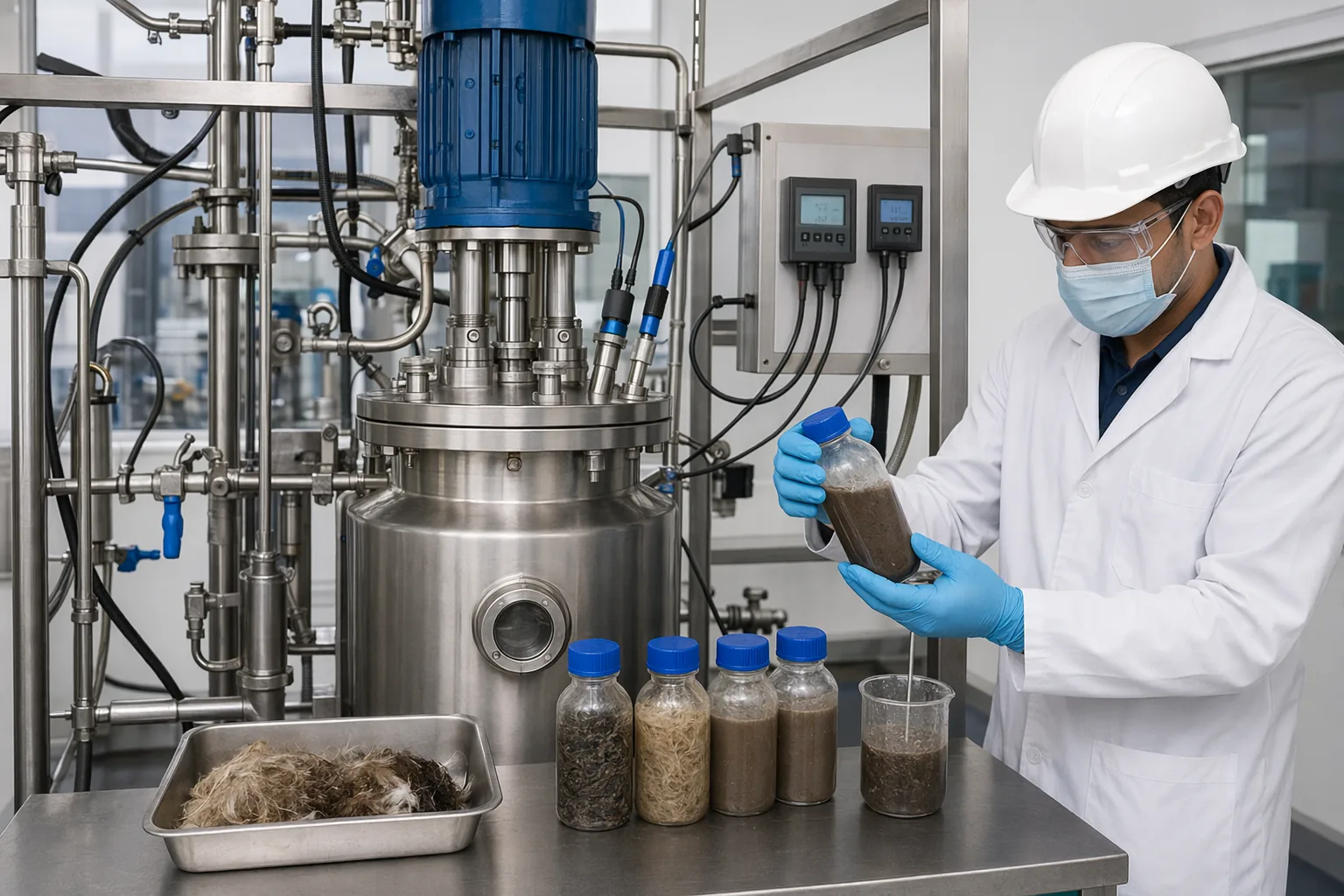
Hair, feather, wool and bristle residues resist ordinary biological treatment: they can add suspended solids, sludge load and odor, and make treatment results swing from day to day. This guide is for waste-treatment managers, by-product processors and the distributors who supply them. It covers how to define the waste before dosing, the starting conditions for an enzyme trial, how to troubleshoot the dose, which QC numbers prove the result after treatment, and what to ask a supplier.
To run a trial, send the product (activity grade), quantity and destination with a short profile of your waste stream; we quote per order.
Why Keratin Waste Needs Enzymatic Control
Keratin-rich residues from hair, feathers, wool, bristles and personal-care manufacturing can resist ordinary biological breakdown. Keratin contains dense disulfide crosslinks and structural proteins that may increase suspended solids, sludge load, odor risk, and treatment variability. In poultry, tannery, rendering, and personal-care waste operations, a keratinase enzyme is used to open and hydrolyze this substrate so that downstream biological or physical treatment can operate more predictably, and so feather or hair residues become easier to pump, separate, dry, or treat. The result should not be judged by appearance alone: it should rest on lab analytics, mass balance, operating data, and a cost-in-use calculation tied to the intended outlet.
Best fit: keratin-rich solid or slurry waste streams • Primary objective: keratin hydrolysis and solids reduction • Decision basis: measurable hydrolysis, not appearance
Define the Before: Feedstock and Baseline Testing
A useful before-and-after study starts with a reliable baseline. Characterize the incoming waste stream before adding keratinase: moisture, dry solids, ash, fat, particle size, pH, temperature, salt, surfactants, preservatives, and any disinfectant residues. Feathers and hair can vary widely by source, washing step, age, and grinding method. For waste treatment, also record COD, BOD if relevant, TKN or total nitrogen, ammonia nitrogen, sulfide risk, odor observations, and settling behavior. If the stream includes salon or personal-care residues, screen for cosmetic additives that may affect foam, emulsification, or enzyme performance. The baseline should be sampled over several production days, not from one convenient grab sample. This protects the buyer from overestimating enzyme performance on an unusually clean or finely milled batch.
Measure dry solids and particle size before dosing • Check inhibitors such as oxidizers, biocides, and high solvent loads • Use composite samples when waste variability is high
Starting Conditions for a Keratinase Trial
A practical trial should begin with a defined substrate, controlled agitation, and measured baseline solids. Our grades are specified for pH 7.0–10.0 and 50–70 °C; set the first trial points inside that window, then narrow them with your own data. Retention time depends on particle size, substrate loading, pretreatment, and the hydrolysis depth you need. Do not assume that a higher temperature or a higher pH always improves results; both can reduce enzyme activity or add corrosion and safety burdens. Check that the final process remains compatible with wastewater biology, dissolved air flotation, dewatering, anaerobic digesters, or other downstream units.
Working window: pH 7.0–10.0, 50–70 °C • Retention time from your own time-course data • Check downstream units before scale-up
Dosage Troubleshooting: From Bench Trial to Plant Dose
Keratinase dosage should be based on actual keratin load, not simply tank volume. For early screening, compare at least three dose levels, by weight of dry keratinaceous solids or as an activity-based series using the declared units per gram. Lower dosages may be sufficient for finely milled feathers or hair sludge, while coarse, chemically treated, or highly crosslinked material may need more enzyme, longer contact time, or mechanical pretreatment. Higher solids reduce tank volume but can limit mixing and mass transfer; mechanical size reduction, feather washing, or mild heat pretreatment may improve access to keratin and lower enzyme cost-in-use. If soluble protein rises but total suspended solids remain high, particle size reduction or agitation may be limiting. If COD spikes without downstream capacity, the process may be hydrolyzing faster than the treatment system can assimilate. A plateau in soluble protein or residual solids reduction points to residence time, mixing, pH control, or substrate accessibility as the limit. The best plant dose is not the maximum dose; it is the lowest validated dose that meets hydrolysis, odor, handling, and discharge objectives at acceptable cost-in-use.
Dose against dry keratin solids where possible • Screen at least three dosage levels • Check both hydrolysis performance and downstream load • Optimize for cost-in-use, not only conversion
Measure the After: QC Checks That Prove Hydrolysis
Keratin hydrolysis should be monitored with more than visual appearance. Useful quality checks include pH before and after dosing, temperature profile, total solids, volatile solids, total suspended solids, soluble protein or peptide release, ammonia or nitrogen shift, COD/BOD ratio, odor observations, and sludge dewaterability. In feather degradation enzyme trials, microscopy or sieve analysis can show whether particles are physically breaking down or only softening. For hair removal or salon-related waste streams, test for surfactants, preservatives, oxidants, and residual chemicals that may inhibit keratinase enzyme activity. A simple enzyme blank and heat-inactivated control can help separate enzymatic effects from thermal or alkaline hydrolysis. Retain samples from each time point and document lot number, dose, mixing speed, and substrate loading so results can be repeated during pilot validation. For a hydrolysate or feather-meal outlet, also assess moisture, crude protein by an accepted method, ash, microbial status when relevant, and batch consistency. A strong pilot report shows data tables, mass balance, enzyme lot number, activity method, and any deviations from the agreed protocol.
Track soluble protein and residual solids • Use blanks and controls • Record enzyme lot and exact process conditions • Check inhibitors in mixed personal-care waste • Confirm downstream compatibility before scale-up
Supplier Qualification and Documentation
For B2B purchasing, a keratinase supplier should support more than a price quote. Request the COA for activity, appearance, and batch release data; the TDS for pH, temperature, dosage, storage, and application guidance; and the SDS for safe handling and transport information. Ask whether the product is liquid or powder, what carriers or stabilizers are present, how activity is defined, and how long performance is retained under your storage conditions. Supplier qualification should also cover lot traceability, sample availability, technical support, lead time, packaging sizes, and change notification practices. Before committing to plant-wide use, complete a bench trial, then a pilot using real waste and real hydraulic conditions. The final comparison should include enzyme price, dose, retention time, energy, chemical savings, sludge impact, and avoided disposal cost.
Request COA, TDS, and SDS • Confirm activity definition and storage stability • Pilot with real substrate and plant constraints • Compare total cost-in-use
Technical Buying Checklist
1. Waste profile: source (hair, feather, wool, bristle or mixed), dry solids, particle size and day-to-day variation.
2. Inhibitors: oxidants, preservatives, surfactants or disinfectant residues in the stream.
3. Window: can the tank hold pH 7.0–10.0 and 50–70 °C for the retention time you need?
4. Trial design: at least three dose levels, an untreated control and a heat-inactivated control.
5. After-treatment targets: soluble protein, residual suspended solids, and the load your downstream units can take.
6. Supply: activity grade (50,000 or 100,000 U/g), pack size (1 kg, 5 kg or 25 kg), quantity and destination for the quote.
Request a Quote for a Waste-Stream Trial
Waste-treatment operators, by-product processors, distributors and resellers request quotes the same way: send the product (activity grade), the quantity and the destination country, with a short profile of your waste stream. Packs are 1 kg, 5 kg and 25 kg, MOQ 1 kg, and price is quoted per order. Free sample included with every qualified inquiry.
Keratinase for Research & Industry
Need Keratinase for your lab or production process?
ISO 9001 certified · Food-grade & research-grade · Ships to 80+ countries
Frequently Asked Questions
Is keratinase the same as a keratin smoothing treatment product?
No. A keratin smoothing treatment is a consumer hair-service term, while keratinase is an industrial enzyme used to hydrolyze keratin-containing waste. In waste treatment, the objective is not hair appearance or cosmetic performance. The objective is to reduce resistant keratin solids, improve handling, and support downstream treatment. Buyers should evaluate enzyme activity, process conditions, safety data, and cost-in-use rather than consumer hair-care claims.
What pH should I use for keratin hydrolysis?
Our grades are specified for pH 7.0–10.0 at 50–70 °C. The best setpoint inside that window depends on the substrate and your downstream treatment, so run bench trials across several pH points. Also confirm that pH adjustment chemicals, corrosion risk, and final effluent neutralization do not create a higher total operating cost.
How do I know if my keratinase dose is too low?
A low dose may show slow soluble protein release, persistent hair or feather particles, limited suspended-solids reduction, or little change versus the untreated control. Before increasing dose, confirm pH, temperature, agitation, particle size, and inhibitors such as oxidants or preservatives. If conditions are correct, run a dosage ladder and compare performance to cost-in-use. The optimum is the lowest dose that meets validated treatment targets.
Can keratinase reduce disposal cost in feather or hair waste?
It can help when keratin hydrolysis improves solids handling, dewatering, biological treatability, odor control, or conversion into a lower-cost outlet. However, savings are site-specific and should not be assumed from lab conversion alone. A proper cost-in-use model should include enzyme dose, energy, pH adjustment, retention time, labor, sludge volume, disposal fees, and any impact on downstream wastewater units.
What documents should I request from a keratinase supplier?
Request a COA for the specific lot, a TDS with operating guidance, and an SDS for handling and safety. Also ask for activity definition, recommended storage, shelf-life guidance, packaging options, sample availability, and technical support for pilot validation. For supplier qualification, confirm traceability, lead time, change notification practices, and whether the enzyme formulation is compatible with your waste chemistry and process equipment.
How do we calculate keratinase cost-in-use?
Cost-in-use combines enzyme dosage, enzyme price, dry substrate loading, reaction time, energy, pH adjustment, mixing, pretreatment, yield improvement, and disposal or treatment savings. A lower price per kilogram may not be cheaper if it requires higher dosage or longer residence time. Use pilot data to compare suppliers on dollars per ton of waste processed or dollars per target outcome.
Plan Your Waste-Stream Trial
Request a keratinase sample, COA/TDS/SDS package, and pilot support for your waste treatment trial. See our application page for hydrolyzed keratin production for specs, MOQ, and a free 50 g sample.
Contact Us to Contributehello@mail.enzymeteam.com